Complete processing solution for high-purity silica sand production.
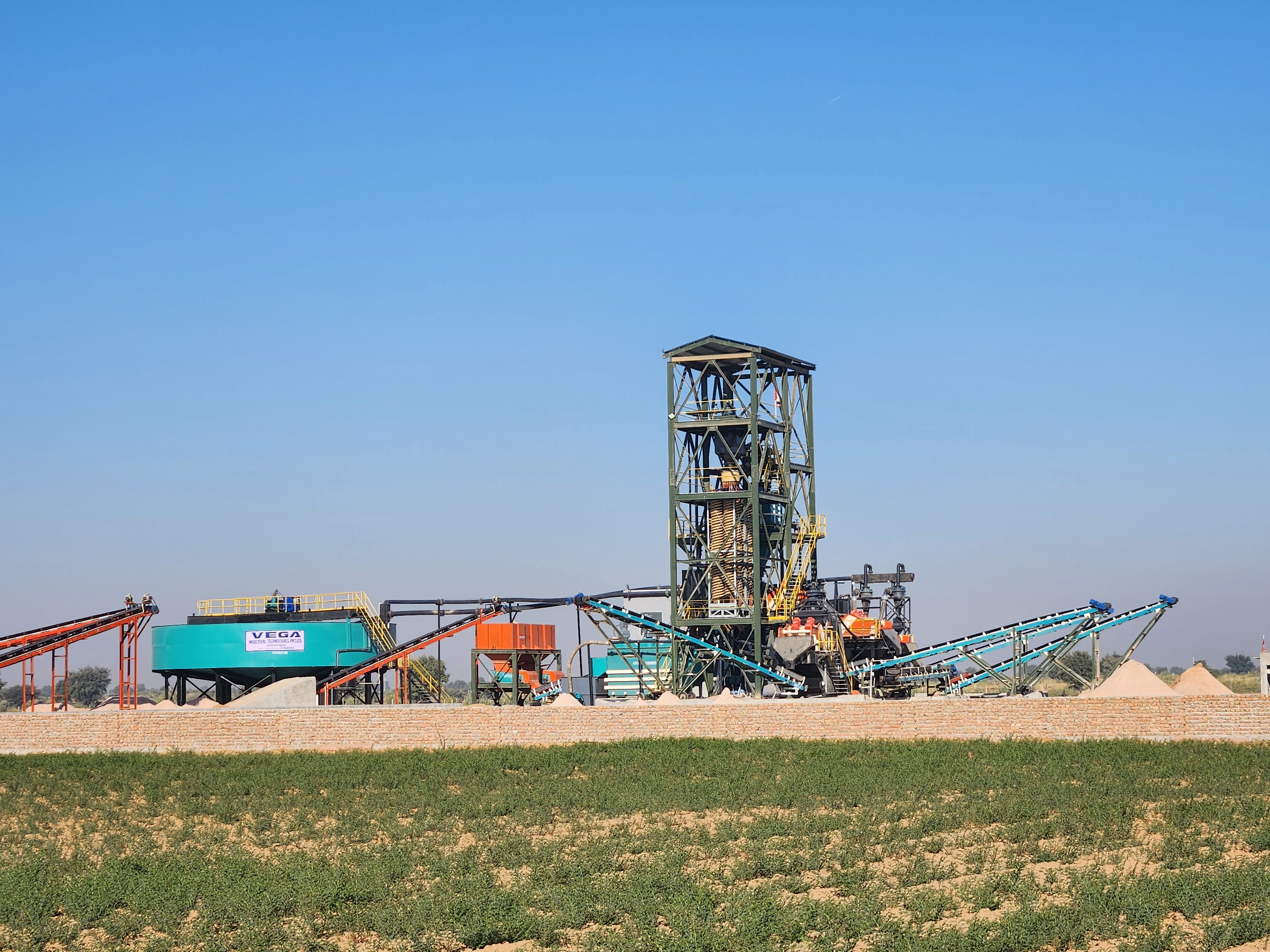
Silica Sand Beneficiation Plants are designed to remove impurities such as clay, silt, iron, and heavy minerals to produce high-grade silica.
The plant integrates washing, classification, attrition scrubbing, and dewatering systems for optimal product quality.
Feed hoppers and belt conveyors form the starting point of any beneficiation plant and are responsible for receiving, storing, and regulating raw material feed. The feed hopper acts as a buffer between mining or unloading operations and downstream equipment, ensuring uninterrupted plant operation. Belt conveyors transfer material smoothly from the hopper to screening, washing, or crushing units with controlled speed and uniform flow. Feed hoppers can be equipped with liners, grizzlies, or vibrating feeders to improve material drawdown and prevent blockages. Together, feed hoppers and conveyors provide consistent feed rate control, protect downstream equipment from surges, and ensure stable plant throughput.
Feed hoppers and belt conveyors form the starting point of any beneficiation plant and are responsible for receiving, storing, and regulating raw material feed. The feed hopper acts as a buffer between mining or unloading operations and downstream equipment, ensuring uninterrupted plant operation. Belt conveyors transfer material smoothly from the hopper to screening, washing, or crushing units with controlled speed and uniform flow. Feed hoppers can be equipped with liners, grizzlies, or vibrating feeders to improve material drawdown and prevent blockages. Together, feed hoppers and conveyors provide consistent feed rate control, protect downstream equipment from surges, and ensure stable plant throughput.
Attrition scrubbers are designed to remove surface coatings, light impurities, and stains from mineral particles through intense particle-to-particle rubbing. They consist of one or more high-speed cells equipped with counter-rotating impellers that create a highly turbulent slurry environment. This scrubbing action effectively dislodges clay films, silt and organic contaminants without significantly reducing particle size. Attrition scrubbers are widely used in silica sand beneficiation to improve brightness and purity. The controlled residence time ensures consistent scrubbing while minimizing energy consumption. Scrubber cells are lined with wear-resistant materials to withstand abrasive operating conditions. Proper attrition scrubbing enhances the effectiveness of downstream classification and magnetic separation processes. These units are designed for continuous operation and can handle high solid concentrations.
Hydrosizer is a gravity-based classifier that separates mineral particles based on size and specific gravity using an upward current flow of water. Finer or lighter particles remain suspended, while heavier or coarser particles settle at the bottom. Vega offers many different sizes based on feed capacity and will provide the proper unit based on your application The Hydro Sizer with HMI (Human–Machine Interface) is an advanced hydraulic classification system designed for precise particle size and density separation. Integrated with an intelligent HMI control system, the Hydro Sizer enables real-time monitoring and control of critical operating parameters such as water flow rate, teeter bed density, feed rate, and underflow discharge, ensuring stable and repeatable classification performance.
A Cylindrical Hydro Cyclone Cluster is a high-capacity classification system used in closed-circuit grinding of ore beneficiation plants. It consists of multiple cylindrical-conical hydro cyclones operating in parallel to efficiently separate fine and coarse particles from ball mill discharge slurry using centrifugal force. Slurry enters each cyclone tangentially through a central feed manifold, creating a high-velocity vortex inside the cylindrical section. Coarse particles are forced outward and discharged through the apex as underflow, returning to the ball mill for further grinding, while fine particles move upward through the vortex finder and report as overflow to the flotation circuit. The cylindrical section stabilizes the vortex and improves separation sharpness, resulting in precise particle size control. Cluster arrangements offer high throughput, operational flexibility, and easy maintenance, as individual cyclones can be isolated without stopping the plant. Hydro cyclone clusters reduce over-grinding, improve energy efficiency, and deliver a consistent flotation feed, making them essential in modern ore beneficiation circuits.
Magnetic separators are essential beneficiation equipment used to remove iron-bearing and magnetic impurities from mineral streams. They operate on Electromagnetic principle that attracts ferrous particles while allowing non-magnetic material to pass freely. Magnetic separation improves final product quality. Heavy-duty construction ensures reliable performance under continuous operation. Their adaptability and proven performance make magnetic separators a critical component in modern Solar glass grade beneficiation plants.
Dewatering screens are used to remove excess water from processed mineral slurry and produce a relatively dry, free-flowing product. They operate using high-frequency vibration and specially designed screen panels that allow water to pass through while retaining solids. Dewatering screens significantly reduce moisture content after washing, classification, or magnetic separation stages. This improves material handling, storage, and transportation efficiency. Screen decks are inclined to enhance drainage performance and ensure consistent discharge. Wear-resistant screen media increases service life under abrasive conditions.
Thickeners play a critical role in treating concentrates and tailings from gravity and magnetic separation circuits. They separate solids from liquids efficiently, producing clear overflow water suitable for reuse in the beneficiation plant. The underflow is thickened sludge, which is directed to filter presses or vacuum belt filters to produce low-moisture filter cake. This reduces handling difficulties and water content, optimizing downstream processing and ensuring compliance with environmental standards. Thickeners contribute to water conservation, efficient tailings management, and sustainable plant operation.
A Filter Press is a high-efficiency dewatering system used in ore beneficiation plants to produce a low-moisture, high-density cake. Thickened slurry is pumped into a series of filter chambers formed by filter plates and cloths. Hydraulic pressure is applied to force liquid through the filter media, retaining solids inside the chambers. As filtration progresses, a compact and uniform cake is formed, while clear filtrate is collected and returned to the process for reuse. Once the filtration cycle is complete, the press opens automatically and the dried cake is discharged for transport or smelting. Due to their high pressure, excellent dewatering performance, and reliable operation, filter presses are widely used for final product dewatering. They reduce transport costs, improve handling efficiency, and support water recovery, making them ideal for modern Manganese ore beneficiation plants.
Vertical Gravity Spirals are advanced gravity separation units designed to remove heavy mineral impurities from silica sand using differences in specific gravity. These spirals are widely used to separate contaminants such as iron-bearing minerals, rutile, ilmenite, garnet, and other heavy minerals, improving silica sand purity and brightness. The vertical gravity spiral operates by feeding slurry at the top of a vertical helical channel. As the slurry flows downward under the combined effects of gravity, centrifugal force, and fluid drag, heavier particles migrate toward the inner profile while lighter silica sand moves outward. The separated fractions are collected through adjustable discharge points, ensuring precise and consistent separation. Spirals feature a compact vertical design, smooth internal surfaces, and wear-resistant construction for long service life. They require no power for separation, resulting in low operating costs and minimal maintenance.
Talk to our engineers for plant design, equipment selection, and commissioning support.
Enquire Now