Detailed View Of the Process
1. Manganese ore crushing process and equipment
Manganese ore crushing is the first step in the process, which involves conventional multi-stage crushing equipment.
Process flow: Vibrating feeder → jaw crusher → cone crusher → vibrating screen
Jaw crusher — primary crushing
The raw manganese ore is transported to the silo by the loading equipment and evenly sent to the jaw crusher by the vibrating feeder for coarse crushing.
Cone crusher — secondary crushing
The belt conveyor sends the coarsely crushed manganese ore to the cone crusher for medium and fine crushing, realizing the principle of more crushing and less grinding.
Vibrating screen — sieving particle size
After sieving by vibrating screen, the manganese ore of desired size is transported to silo. The coarser particles shall be returned to the cone crusher for further crushing.
2. Manganese ore washing process and equipment
To remove the gangue minerals from manganese ore, the washing process is must in order to improve the process index of manganese beneficiation. The ore can be washed directly on the vibrating screen can be used for cleaning.
WET VIBRATING SCREEN
The working principle of a vibratory screen is quite simple, which makes it easy to operate. Vibrating source comes from self-vibro motors that transmits vibration to the screen deck, which makes material shaking and distributing evenly on the screen. During the process, the large size of material will stay on the top while the small and fine size material can go throughout the screen mesh to the bottom.
Based on the material product size required, the number of screen deck required shall be decided.
Over Band Magnetic Separator
An Over band Magnetic Separator is a critical piece of equipment in manganese ore beneficiation plants, designed to efficiently remove ferrous tramp iron and magnetic contaminants from conveyed material. Installed above belt conveyors, it ensures clean feed material, protects downstream crushing and screening equipment, and improves overall plant reliability.
In manganese ore processing, tramp iron originates from mining operations, drilling tools, crusher wear parts, and conveyor components. If not removed, these metallic impurities can:
• Damage crushers, screens, and Ball mills
• Reduce separation efficiency in downstream processes
• Increase maintenance and downtime
3. Manganese ore grinding process and equipment
The crushed manganese ore is grinded into finished products of required specifications by the Ball mill.
Ball mill
Ball mill can grind ore to relatively fine and uniform particle size. The manganese ore of desired size is sent to the ball mill for grinding, and it can be ground into manganese powder of 0-1 mm.
Screw classifier
The screw classifier is indispensable classification equipment. According to the different settling speeds of solid particles, it can classify manganese particles and also play the role of desliming.
4. Manganese ore dressing process and equipment
According to the manganese ore plant, different types of manganese ore have the different process flows. To choose different beneficiation equipment:
Manganese oxide ore
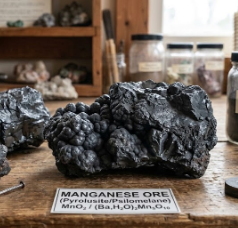
Such as psilomelane, pyrolusite, manganite, etc.
Applicable to gravity separation method: Jig machine → shaking table
Manganese carbonate ore
Such as rhodochrosite, calcium rhodochrosite, calcite with manganese, etc.
Applicable to flotation or flotation-magnetic separation: Flotation machine → magnetic separator
For polymetallic composite manganese ore , the ore composition is more complex. The manganese minerals are not easy to dissociate. To combine mineral components, methods such as washing, gravity separation, flotation, magnetic separation, and roasting shall be comprehensively adopted.
Gravity Separation
Shaking table
The shaking table is suitable for selecting fine-grained manganese oxide ore, which can obtain high-grade concentrate and waste tailings. It is easy to operate and has high sorting efficiency.
Jig machine
The jig is suitable for processing coarse-grained manganese ore, and it is a kind of equipment for sorting by using the density difference between minerals and gangue.
Flotation machine
The flexibility of flotation is relatively high. Reagents vary according to the type and grade of ore. Most manganese ore plants adopt an anionic reverse flotation process to obtain high-grade manganese concentrate.
- A motor drives an impeller (rotor) at the bottom.
- The impeller's rotation creates low pressure, sucking air (or external air is introduced) into the cell.
- The Rotor action thoroughly mixes the air, water, reagents, and ore particles, breaking air into fine bubbles.
- Chemical reagents (collectors) make target minerals hydrophobic (water-repelling).
- These hydrophobic minerals attach to the air bubbles, forming mineralized bubbles.
- A mechanical scraper skims the mineral-rich froth from the surface into a launder (trough). This froth is the valuable concentrate product.
- Unwanted hydrophilic (water-loving) minerals, along with water, sink to the bottom. This tailings slurry is discharged from the cell through the Dart valve.
Magnetic separator
Manganese is a weakly magnetic mineral, which can be effectively separated by strong magnetic separation. This machine is used for iron removal of manganese ore, which is beneficial to achieve desired product recovery and grade.
5. Manganese ore drying process and equipment
After beneficiation, the manganese ore concentrates and tailings are discharged out of the machine with a large amount of water. To be transported to the concentrate plant or tailing plant, they must be dewatered.
High-Rate Concentrate Thickener
Thickener separates solids from liquid by producing a high-density manganese concentrate slurry. Thickeners operating to produce the concentrate from the thickener underflow. Overflow water recycled back to the plant reducing overall water consumption. Suitable flocculants are added based on the mineral characteristics to promote rapid settling of fine particles. The thickened solids settle at the bottom and are gently moved by rotating rake arms toward the central discharge cone.
The thickener underflow is a dense, high-solids concentrate suitable for downstream dewatering using filter press. Clarified water overflows from the top of the thickener and is recovered for reuse in the process.
By increasing concentrate density, reducing moisture load on filters, and improving water recovery, high-rate concentrate thickeners enhance plant efficiency, lower operating costs, and support sustainable ore beneficiation operations.
High-Rate Tailing Thickener
A Tailing Thickener is a key solid-liquid separation unit used in Manganese ore beneficiation plants to recover water from the tailings before disposal. Tailings, typically containing fine gangue particles, are fed into the thickener tank, where flocculants are added to promote rapid settling. The fine solids settle at the bottom to form a dense underflow slurry, while clarified water overflows from the top and is recycled back into the plant, reducing freshwater consumption.
The thickener is equipped with a rotating rake mechanism that gently moves the settled solids toward the central discharge point for continuous underflow removal. Tailing thickeners are designed for high throughput, stable operation, and minimal maintenance, even with abrasive and fine-grained slurries.
By concentrating tailings, tailing thickeners reduce the volume of slurry sent to tailings dam, lower pumping energy, improve water recovery, and support sustainable operations in ore beneficiation plants.
Filter Press – Concentrate Dewatering and Tailings Dewatering
A Filter Press is a high-efficiency dewatering system used in ore beneficiation plants to produce a low-moisture, high-density cake. Thickened slurry is pumped into a series of filter chambers formed by filter plates and cloths. Hydraulic pressure is applied to force liquid through the filter media, retaining solids inside the chambers.
As filtration progresses, a compact and uniform cake is formed, while clear filtrate is collected and returned to the process for reuse. Once the filtration cycle is complete, the press opens automatically and the dried cake is discharged for transport or smelting.
Due to their high pressure, excellent dewatering performance, and reliable operation, filter presses are widely used for final product dewatering. They reduce transport costs, improve handling efficiency, and support water recovery, making them ideal for modern Manganese ore beneficiation plants.
Rotary dryer
Drying is the last step in manganese ore processing and the rotary drum dryer is the best choice. It can remove excess water from manganese minerals and obtain dry manganese powder.