Process Flow
Primary Crusher (Jaw Crusher)
A Jaw Crusher is a heavy-duty primary crusher used to reduce large Run-of-Mine (ROM) copper ore into manageable sizes for secondary crushing and grinding.
It operates on the compression principle, making it ideal for hard and abrasive ores.
Single Toggle Jaw Crusher
• One toggle plate
• Higher capacity
• Lower weight
• Most commonly used in copper plants
Double Toggle Jaw Crusher
• Two toggle plates
• Higher crushing force
• Suitable for very hard and abrasive ores
Secondary/Tertiary Crushing (Cone Crusher)
Cone crusher reduces material from the primary crusher to a uniform, fine size, making it ideal for feeding grinding mills.
Cone crushers operate on the compression principle,
providing high reduction ratios with excellent product shape and consistent output.
Standard Cone Crusher
• It’s for secondary crushing
• Produces coarser output
Short Head Cone Crusher
• Used for tertiary crushing
• Produces finer product
Hydraulic Cone Crusher
• Automatic setting adjustment
• Overload and tramp metal protection
Vibrating Screens for size classification
Vibrating Screens are essential classification equipment used to separate crushed ore into precise size fractions.
By ensuring correct feed size to downstream crushers and grinding mills,
they enhance plant efficiency, reduce energy consumption, and improve overall product recovery.
Single Deck Vibrating Screen
• Used for simple separation
• Common in primary screening
Linear Motion Vibrating Screen
• High capacity
• Efficient for wet and dry screening
Circular Motion Vibrating Screen
• Excellent stratification
• Widely used in mineral processing
Double / Triple Deck Screen
• Used for multi-size classification
• Ideal for secondary and tertiary circuits
Grinding & Classification
Rod Mill
A Rod Mill is a coarse grinding machine used to reduce crushed ore to a uniform particle size with minimal fines generation. It consists of a rotating cylindrical shell partially filled with steel rods, which grind the ore primarily by line contact and abrasion. This grinding mechanism produces a narrow size distribution, making rod mills ideal for primary grinding applications.
Crushed ore is fed into the rod mill, where the rotating motion causes the rods to cascade and tumble, breaking the particles through impact and attrition. The ground material exits through the discharge end and is typically directed to a ball mill or downstream classification equipment. Rod mills are commonly operated in open circuit and are especially effective when over-grinding must be avoided.
By producing a consistent and controlled feed size, rod mills improve the efficiency of secondary grinding and flotation processes. Their simple, robust design, low fines generation, and reliable performance make rod mills a valuable component in staged ore grinding circuits.
Ball Mill
A Ball Mill is to reduce crushed ore generated from rod mill into fine particles for effective mineral liberation prior to flotation. It consists of a rotating cylindrical shell partially filled with steel grinding balls, which grind the ore through impact and attrition as the mill rotates. The continuous cascading action of the balls ensures efficient size reduction and uniform particle distribution. Crushed ore is fed into the ball mill, where it is ground to the required size, typically in the micron size range. Ball mills are commonly operated in closed circuit with hydro cyclone clusters, which classify the mill discharge. Fine particles report to the flotation circuit, while coarse material is returned to the mill for further grinding. This closed-circuit operation prevents over-grinding and improves energy efficiency.
Ball mills offer reliable performance, flexible capacity, and consistent product size control. Their proven design and ability to handle hard and abrasive ores make them an essential component of modern ore beneficiation grinding circuits.
Hydro Cyclone Cluster
A Cylindrical Hydro Cyclone Cluster is a high-capacity classification system used in closed-circuit grinding of ore beneficiation plants. It consists of multiple cylindrical-conical hydro cyclones operating in parallel to efficiently separate fine and coarse particles from ball mill discharge slurry using centrifugal force. Slurry enters each cyclone tangentially through a central feed manifold, creating a high-velocity vortex inside the cylindrical section. Coarse particles are forced outward and discharged through the apex as underflow, returning to the ball mill for further grinding, while fine particles move upward through the vortex finder and report as overflow to the flotation circuit.
The cylindrical section stabilizes the vortex and improves separation sharpness, resulting in precise particle size control. Cluster arrangements offer high throughput, operational flexibility, and easy maintenance, as individual cyclones can be isolated without stopping the plant. Hydro cyclone clusters reduce over-grinding, improve energy efficiency, and deliver a consistent flotation feed, making them essential in modern copper ore beneficiation circuits.
Flotation system
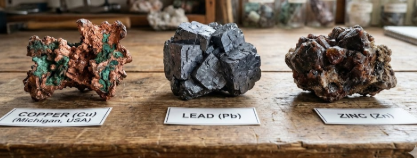
Flotation is a key beneficiation process used to separate valuable copper, Lead and Zinc minerals from gangue material after grinding. The finely ground ore slurry from the grinding circuit is conditioned with specific reagents, including collectors, frothers, and modifiers, which enhance the hydrophobic properties of respective minerals. This treated slurry is then fed into flotation cells, where air is introduced to generate fine bubbles.
The mineral particles attach to the air bubbles and rise to the surface, forming a stable froth layer that is skimmed off as Copper concentrate, Lead concentrate, Zinc concentrate. Non-valuable gangue minerals remain in the slurry and are discharged as tailings. Flotation circuits typically include rougher, scavenger, and cleaner stages to achieve high recovery and concentrate grade.
Flotation provides efficient mineral separation, high recovery rates, and consistent concentrate quality. It is the most widely used and proven method for upgrading sulfide copper, Lead and Zinc ores in modern mineral beneficiation plants.
A motor drives an impeller (rotor) at the bottom.
The impeller's rotation creates low pressure, sucking air (or external air is introduced) into the cell.
The Rotor action thoroughly mixes the air, water, reagents, and ore particles, breaking air into fine bubbles.
Chemical reagents (collectors) make target minerals hydrophobic (water-repelling).
These hydrophobic minerals attach to the air bubbles, forming mineralized bubbles.
A mechanical scraper skims the mineral-rich froth from the surface into a launder (trough). This froth is the valuable concentrate product.
Unwanted hydrophilic (water-loving) minerals, along with water, sink to the bottom. This tailings slurry is discharged from the cell through the Dart valve
High-Rate Concentrate Thickener